Domestic Fire Alarm Certificates
Domestic fire alarm certificates are based on BS 5839-6 Annex E and are officially know as Certificate of Design, Installation and Commissioning of a Fire Detection and Fire Alarm System for Grade C, D and F Systems, they are also known as Grade D Fire Alarm Installation Certificate or Smoke Alarm Installation Certificate.
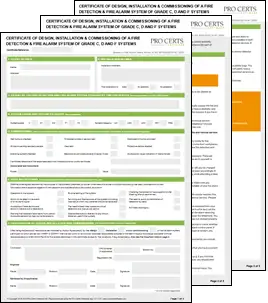
Fire Alarm Certification Software
Create your domestic fire alarm certificates with our Pro Certs (electrical certification software) app which includes domestic fire alarm commissioning certificate template forms, electrical, ventilation and emergency lighting certificates.
System Grades
A domestic fire alarm “grade” specifies how the system is powered and controlled. Domestic fire/smoke alarm systems are generally graded as either grade C, D1, D2, F1 or F2. HMO’s normally require a Grade A system.
At a glance, the common fire alarm grades for dwellings are,
|
Grade |
Power Source |
*Best for (2025 Guidance) |
|---|---|---|
|
Grade A |
230V Mains + Standby Battery + Central Panel |
HMO’s & High Risk Sheltered Housing |
|
Grade C |
230V Mains + Standby Battery + Central Control |
Dwellings with Complex Layouts or Specific Risks |
|
Grade D1 |
230V Mains + Tamper-Proof Standby Batteries |
New Builds, Social Housing & Rented Accommodation (individual flats, houses, bungalows). |
|
Grade D2 |
230V Mains + User Replaceable Standby Batteries |
Low Risk Existing Owner-Occupied Upgrades |
*Always conduct a fire risk assessment to determine risks specific to your property and consult your insurance provider and the local authority to check for any further specific requirements, along with checking the current edition of any relevant regulations.
For new systems, a Grade D1 system is the minimum grade of system required for the majority of domestic properties (excluding HMO’s).
Grade A Fire Alarms
For context, a Grade A fire alarm system, under British Standards (BS 5839-1), is the most advanced type, featuring a central control panel, interconnected detectors (smoke/heat), sounders, manual call points, and a reliable backup power supply, meeting high reliability standards (like BS EN 54) for maximum protection, typically in commercial & industrial buildings or HMOs.
Note: Grade A fire alarms are covered by BS 5839-1 not BS 5839-6.
BS 5839-1: Fire detection and fire alarm systems for buildings – Design, installation, commissioning and maintenance of systems in non-domestic premises.
BS 5839-6: Fire detection and fire alarm systems for buildings – Code of practice for the design, installation, commissioning and maintenance of fire detection and fire alarm systems in domestic premises.
Grade C Fire Alarms
A Grade C system is a system of fire detectors and alarm sounders (which may be combined in the form of smoke alarms) connected to a common power supply (can be paired with an intruder alarm), comprising the normal mains and a standby supply, with central control equipment.
For grade C systems, the mains electrical supply should be derived from an independent circuit at the dwelling’s main distribution board. No other electrical equipment should be connected to this circuit.
Grade D Fire Alarms
Grade D fire alarm systems are a domestic system using mains-powered detectors with battery backup and consists of grades D1 and D2. The “1” and “2” determines the type of standby battery.
- Grade D1 = Tamper-proof battery (such as a non-replaceable sealed 10 year lithium battery).
- Grade D2 = User replaceable battery (such as a 9V battery).
(1: Tamper-proof battery, 2: User replaceable battery).
For further details and specifications for Grade D fire alarms, see our post Guide to Grade-D Fire Alarm Systems or The Practical Guide to Grade-D Fire Alarm Systems on Amazon.
Grade D1: A system of one or more mains-powered detectors, each with a tamper‑proof standby supply consisting of a battery or batteries.
Building regulations and social housing providers have almost entirely moved to Grade D1 (mains with tamper-proof lithium batteries) over the older Grade D2 (replaceable batteries).
D1 is preferred over D2 because it prevents tenants and householders from disabling alarms by removing the batteries.
Grade D2: A system of one or more mains-powered detectors, each with an integral
standby supply consisting of a user‑replaceable battery or batteries.
Grade F Fire Alarms
A Grade F fire alarm system is a domestic system using only batteries and consists of grades F1 and F2. The “1” and “2” determines the type of battery.
Grade F1: A system of one or more battery-powered detectors powered by a tamper‑proof primary battery or batteries.
Grade F2: A system of one or more battery-powered detectors powered by a user‑replaceable primary battery or batteries.
Detectors might be in the form of smoke detectors, heat detectors or combined units. Most manufacturers also offer Carbon Monoxide detectors.
Fire Alarm Interlink
The interlink connection between detectors could be either hardwired, wireless, or a combination of both. The interlink function sends a signal from the detector which has detected a fire to all the other detectors to activate their sounders in the event of a detection.
BS 5839-6 digital commissioning forms: Certificate of Design, Installation and Commissioning of a Fire Detection and Fire Alarm System for Grade C, D and F Systems.
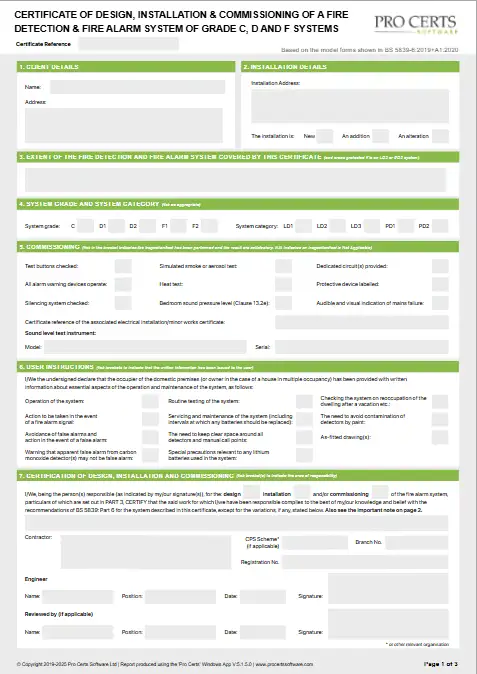

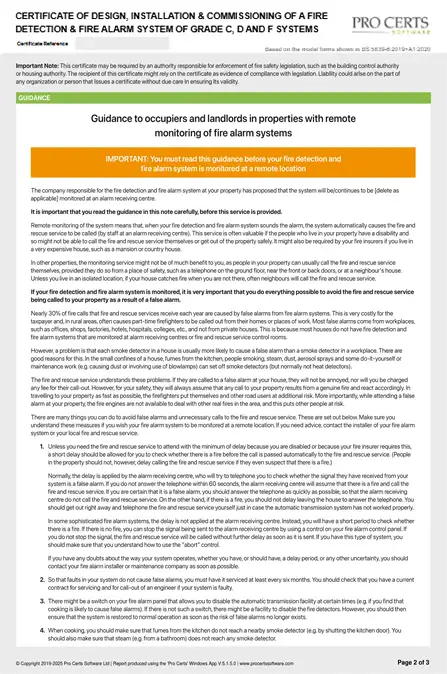
Get your domestic fire alarm certificates today with our Pro Certs App.
Domestic Fire, Electrical, Emergency Lighting & Domestic Ventilation Certs.
System Categories
A fire alarm “category” specifies the type and level of protection such as, where detectors are located and what areas are protected.
Domestic fire alarm systems are usually installed in dwellings to protect life (L), but may also be installed to protect property (P).
Domestic fire alarm systems are divided into the following categories: LD1, LD2, LD3, PD1 and PD2
The letters indicate the type of protection, the number indicates the level of protection.
Type of Protection:
- LD = Protection of life.
- PD = Protection of property.
L= Life, P = Property, D = In Dwellings.
Level of Protection:
- 1 = High.
- 2 = Medium.
- 3 = Low.
System categories for the protection of life (LD):
Category LD1: A system installed throughout the premises, incorporating detectors in all circulation areas that form part of the escape routes from the premises, and in all rooms and areas, other than those with negligible sources of ignition, such as toilets, bathrooms and shower rooms.
Category LD2: A system incorporating detectors in all circulation areas that form part of the escape routes from the premises, and in all specified rooms or areas that present a high fire risk to occupants, including any kitchen and the principal habitable room.
Category LD3: A system incorporating detectors in all circulation areas that form part of the escape routes from the premises.
All domestic premises need to be provided with an appropriate fire detection and fire alarm system. The
greatest benefit to life safety is given by a full‑coverage system (Category LD1). Such a system gives the
earliest practicable warning of fire to occupants, wherever ignition occurs.
Systems categories for the protection of property (PD):
Category PD1: A system installed throughout the premises, incorporating detectors in all rooms and areas in which fire might start, other than toilets, bathrooms and shower rooms.
Category PD2: A system incorporating detectors only in defined rooms or areas of the premises in which the risk of fire to property is judged to warrant their provision.
A fire can start virtually anywhere in domestic premises, although the probability of fire varies
significantly from one room to another. If the fire is not detected at an early stage, it can grow until it
becomes difficult or impossible to extinguish. The highest level of property protection is therefore given
by a Category PD1 system (giving full coverage of all parts of the premises).
Get your domestic fire alarm certificates today with our Pro Certs App.
Domestic Fire, Electrical, Emergency Lighting Certificates & Domestic Ventilation Cerificates.
The Electricians Guide to Fire Detection and Fire Alarm Systems
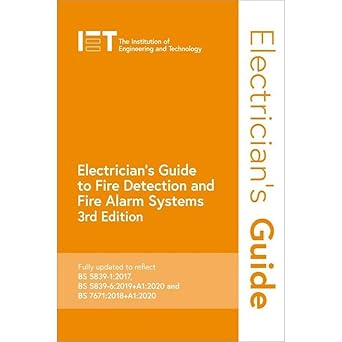
If you are unfamiliar with the requirements of BS 5839, this Electrician’s Guide to Fire Detection and Fire Alarm Systems is very helpful and informative and is ideal for individuals involved in the design and installation of fire detection systems as part of electrical installations.
It offers information, advice, and guidance on managing BS 7671 and BS 5839 requirements.
Fire alarm regulations are constantly evolving and being updated, so it is imperative to ensure you are working to the latest version of the relevant regulations and local authority requirements.
References: BS 5839-6 Fire detection and fire alarm systems for buildings – Code of practice for the design, installation, commissioning and maintenance of fire detection and fire alarm systems in domestic premises.
Fire Alarm Installation Certificates for Dwellings.

Most commonly, for standard domestic (dwellings) properties for grade D systems, a grade D fire alarm certificate is issued.
Always check with the current relevant regulations and local authority requirements to ensure the correct Grade and Category of fire detection system is specified, designed and installed.
It’s also worth noting that insurance policies may also have their own additional requirements, such as for Thatched properties and high risk areas.
What is a Domestic Fire Alarm Certificate?
A Domestic Fire Alarm Certificate is an official document confirming a home’s fire alarm system has been professionally installed, tested, and meets UK British Standards (BS 5839-6) for safety and functionality, acting as proof for landlords, insurers, and buyers that the property is adequately protected, often required for rented properties and renewed periodically, typically yearly.
HMO Fire Alarm Certificate
For HMO’s it is very likely a Grade A system based on BS 5839-1. Larger or higher-risk domestic properties requiring a Grade A system (with a central control panel) must now comply with the significant technical changes introduced in BS 5839-1:2025.
FAQ’s
Yes, if compliant with BS 5839-6 or BS 5839-2 (depending on requirements).
A grade D1 requires a tamper-proof backup battery(ies), a grade D2 has user a replaceable backup battery(ies). Most 2025 specifications now mandate D1.
Most rental properties (new and existing) are now required to meet Grade D1, Category LD2 standards. Digital certification is the preferred method for landlords to prove “Duty of Care.”
Under current 2025 guidance, CO alarms can be interlinked with the fire system.
Yes, particularly for HMOs and rental properties in England and Wales. Since 2022 and updated in 2025, landlords must prove alarms are working at the start of every tenancy.
Get your domestic fire alarm certificates today with our Pro Certs App.
Domestic Fire, Electrical, Emergency Lighting & Domestic Ventilation Certs.