5 Reasons Why Electricians Should Not Rely on AI – With Examples.
While AI (Artificial Intelligence) can have its uses, it can not be relied upon for answering electrical queries or technical questions relating to BS 7671 wiring regulations, or for any electrical installation work or guidance.
AI does not have direct access to BS 7671 or any of the supporting documents such as the Guidance Notes or Design Guides, because those documents are copyrighted by the IET.
Therefore, for any AI agent to answer your prompt (question), it will scour the internet for a matching phrase to your question and then return the results in its own words.
This means that for any AI agent or tool to answer your question it will return a snippet of text it found on a website somewhere, the answer could just be plain wrong, out of date, or worst case dangerous.
If you use AI for solutions to electrical issues, cable sizing or regulation guidance, what do you tell your client if its wrong?
Sorry your electrical project is dangerous/non-compliant, the AI tool I used gave me the wrong information because I don’t value your business enough and I cant be bothered to do it myself.
That would be an embarrassing and costly mistake.
More worrying is the number of DIY enthusiasts turning to AI rather than consulting an Electrician.
We tested AI for a few commonly asked electrical questions and found most of the time it returned the wrong answer.
We also found that different AI agents gave a different answer to the same question, this again is likely due to where the specific AI agent sourced its information from.
We asked an AI agent “Why shouldn’t Electricians Use AI for BS 7671 Regulations advice?” and itself responded with,
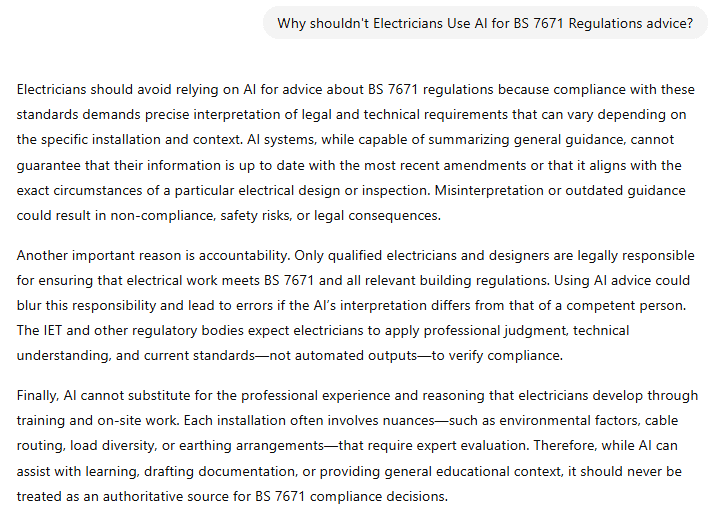
So as you can see from the screenshot above, AI itself advises you not to rely upon it.
5 Reasons Electricians Should Not Rely On AI
- AI does not have access to BS 7671.
- AI does not have access to any of the Guidance Notes.
- AI relies on information from public accessible websites (be that right or wrong).
- Is generally out of date.
- Can not interpret real world scenarios or specific cases.
AI Example Prompts and Answers
During our research we used a variety of different AI agents, we asked them a few simple electrical questions relating to the UK Wiring Regulations.
AI Prompt #1:
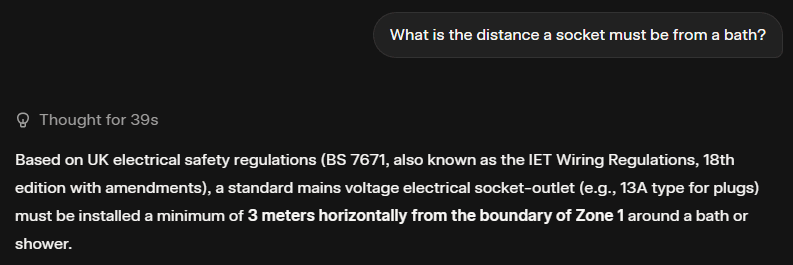
✗ AI Answer = 3m Incorrect.
✓ Correct Answer = Regulation 701.521.3 = 2.5m.
AI Prompt #2:
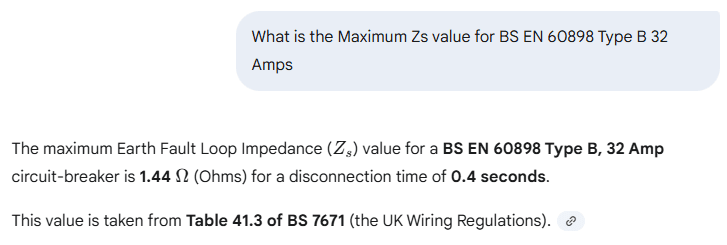
✗ AI Answer = 1.44 Ω Incorrect.
✓ Correct Answer = 1.37 Ω.
AI Cable Calc Prompt #3:
We have removed the full calculation explanation because is was quite long.
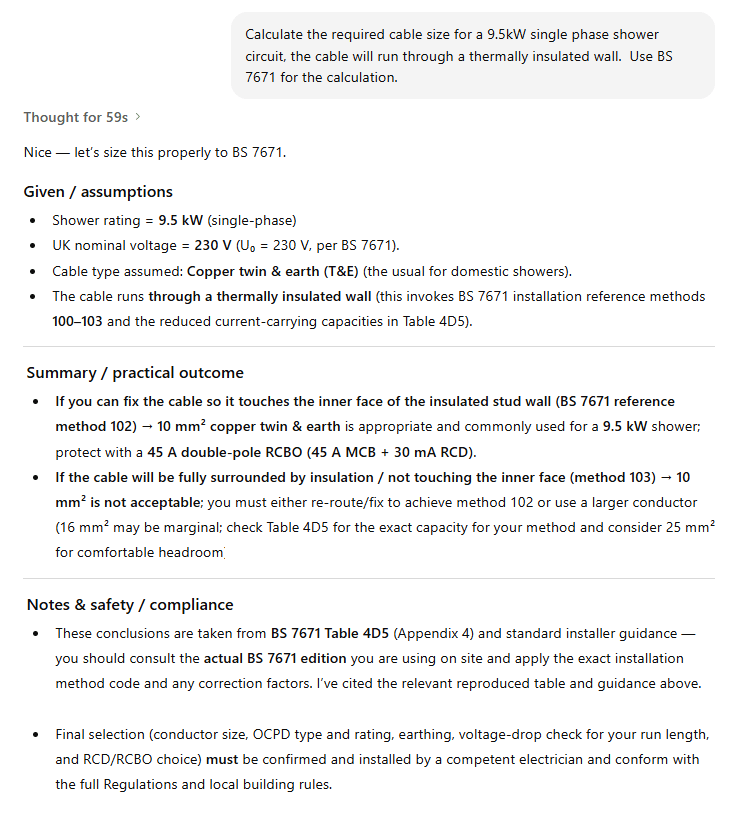
The issue with AI cable calculations are the assumptions, also it missed out vital calculation steps such as the maximum permitted Zs for fault protection.
- Assumed the length of circuit.
- Assumed the MCB type (type unknown).
- Did not take Ze into account (for Max Zs compliance).
- Asks you to check table 4D5 yourself.
It did not ask for the length or circuit (run) for its voltage drop calculation, nor did it take into account of the type of MCB (i.e. type B, C, D), or ask what the Ze value is to check against the maximum Zs value depending on the selected MCB type.
AI Prompt #4: What don’t you know about the UK wiring regulations BS 7671?
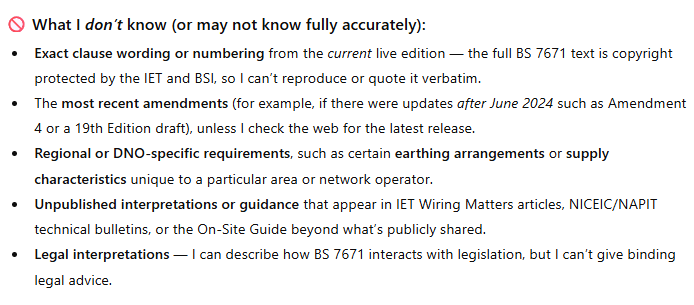
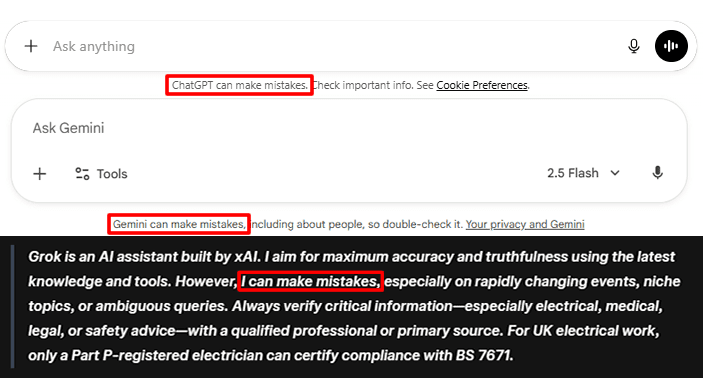
AI Can Make Mistakes:
If the best AI tools in the world can make mistakes, then so can any other AI tool or agent. Yes, humans can also make mistakes, but we can learn from ours.
Don’t let AI de-skill you, thrive to be the best on your field and learn from trusted sources and professionals who have been there and done it for real. AI can not replace or replicate real world experience.
Conclusion:
AI will respond to your specific prompt, so if you are asking AI for a solution, it will unlikely suggest the correct solution, partly due to the prompt you use.
For example, if you ask AI to calculate a cable size for you, but you do not know you must allow for any pre-existing voltage drop from the source up to the point from where you are calculating from, AI will not take that into account because you didn’t tell it to.
If you use AI, you should check its results against official sources such as the relevant regulations, BS 7671, IET Guidance Notes and any associated Building Regulations, amongst others.
If by using AI you have to ensure compliance and safety by manually checking its results, you may as well save time and just do that in the first instance, also it’s good practice to keep your skills sharp rather than relying on AI to solve everything for you, which may or may not be correct.
Don’t use AI for electrical guidance, assistance or to solve your electrical problems, if in doubt, seek expert advice from a trusted source, not an AI agent.