Maximum Demand Calculator
This maximum demand calculator will calculate the total connected load and will apply diversity to each circuit to get the total after diversity maximum demand (ADMD) for single phase and three phase circuits, distribution boards and consumer units.
For completeness, this max demand calculator can use three different rules or methods to set and apply the diversity factor values, also with an additional manual option to apply a usage factor (UF) to the already diversified load (DL 1).
In addition to automatically applying diversity in accordance with BS 7671 on-site guide Appendix A, you can override this to suit your own requirements, this can be achieved by selecting Type of Premises “Custom”, or for a specific circuit, Type of Circuit “Custom”, this will enable you to enter and apply your own diversity factor to meet your own specific needs or scenario.
Applying diversity to the total connected load can be daunting and confusing, until now, try using our new web based online electrical diversity calculation software → online electrical software.
For clarity, this maximum demand calculation software was written and developed by actual electrical engineers with over 30 years experience in the electrical industry. No AI is/was used in any part of the max demand calculations, meaning it is completely free from AI therefore reducing the risks of errors and mistakes – hand built in the UK by humans, for humans.
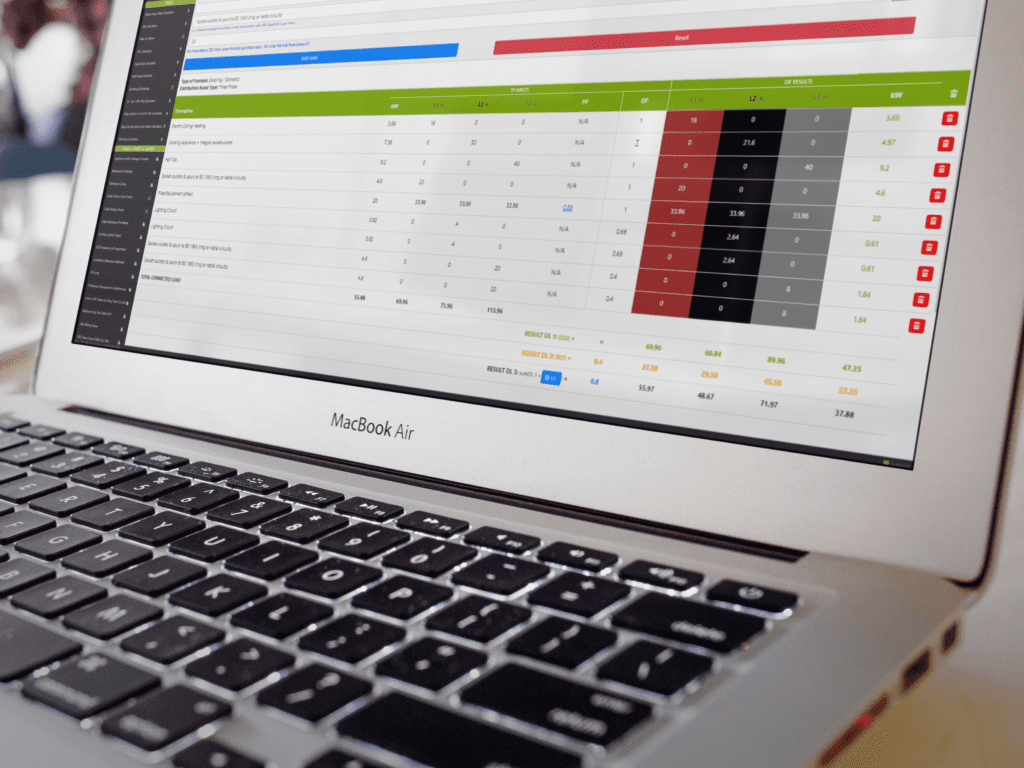
Maximum Demand Software
- Add your loads to calculate the total connected load.
- Apply diversity.
- Calculate the after diversity maximum demand (ADMD).
- Save as PDF or print the results
Diversity Factors
This advanced maximum demand calculator can utilise 4 different methods for determining diversity factors, such as:
- BS 7671 On-Site Guide Appendix A.
- Rule of Thumb Method (ROT).
- Apply your own diversity factors.
- Apply an additional Usage Factor (UF).
Allowances for diversity across different types of premises
Diversity factors table (see notes below for * and †)
| Purpose of the final circuit fed from the conductors or switchgear to which the diversity applies | Type of premises | ||
|---|---|---|---|
| Individual household installations, including individual dwellings of a block | Small shops, stores, offices and business premises | Small hotels, boarding houses, guest houses, etc. | |
| 1 Lighting | 66% of total current demand | 90% of total current demand | 75% of total current demand |
| 2 Heating and power (but see 3 to 8 below) | 100% of total current demand up to 10 A +50% of any current demand in excess of 10 A | 100% full load of largest appliance +75% full load of remaining appliances | 100% full load of largest appliance +80% full load of second largest appliance +60% full load of remaining appliances |
| 3 Cooking appliances | 10 A + 30% full load of connected cooking appliances in excess of 10 A + 5 A if a socket-outlet is incorporated in the control unit | 100% full load of largest appliance +80% full load of second largest appliance +60% full load of remaining appliances | 100% full load of largest appliance +80% full load of second largest appliance +60% full load of remaining appliances |
| 4 Motors (other than lift motors, which are subject to special consideration) | Not applicable | 100% full load of largest motor +80% full load of second largest motor +60% full load of remaining motors | 100% full load of largest motor +50% full load of remaining motors |
| 5 Water heaters (instantaneous type)* | 100% full load of largest appliance +100% full load of second largest appliance +25% full load of remaining appliances | 100% full load of largest appliance +100% full load of second largest appliance +25% full load of remaining appliances | 100% full load of largest appliance +100% full load of second largest appliance +25% full load of remaining appliances |
| 6 Water heaters (thermostatically controlled) | No diversity allowable† | No diversity allowable† | No diversity allowable† |
| 7 Floor warming installations | No diversity allowable† | No diversity allowable† | No diversity allowable† |
| 8 Thermal storage space heating installations | No diversity allowable† | No diversity allowable† | No diversity allowable† |
| 9 Standard arrangement of final circuits in accordance with Appendix H | 100% of current demand of largest circuit +40% of current demand of every other circuit | 100% of current demand of largest circuit +50% of current demand of every other circuit | |
| 10 Socket-outlets (other than those included in 9 above and stationary equipment other than those listed above) | 100% of current demand of largest point of utilisation +40% of current demand of every other point of utilisation | 100% of current demand of largest point of utilisation +70% of current demand of every other point of utilisation | 100% of current demand of largest point of utilisation +75% of current demand of every other point in main rooms (dining rooms, etc.) +40% of current demand of every other point of utilisation |
|
Notes: * In this context an instantaneous water heater is considered to be a water heater of any loading that heats water only while the tap is turned on and therefore uses electricity intermittently. † It is important to ensure that distribution boards or consumer units are of sufficient rating to take the total load connected to them without the application of any diversity. |
|||
Wart to learn more? → Learn how diversity is calculated.
Max Demand Calculation Results
Maximum demand calculation results and diversity factor application methods:
- Result DL 1: (OSG) = Based on BS 7671 Appendix A of the On-Site Guide
- Result DL 1: (Custom) = Based on your own diversity factor values.
- Result DL 2: (ROT) = Based on the Rule of Thumb (ROT) method.
- Result DL 3: DL 1 x UF = DL 1 x UF (Usage Factor).
DL = Diversified Load.
On-Site Guide Appendix A
BS 7671 On Site Guide Appendix A – Maximum demand and diversity: Appendix A sets outs the demand to be assumed and factors to be applied to the total connected load for the purpose of calculating the maximum demand for electrical installations.
The On-Site Guide updated to BS 7671:2018+A4:2026 (Amendment 4) can be purchased on Amazon UK Amendment 4 On-Site Guide.
Table A1
Table A1 details current demand to be assumed for points of utilization and current-using equipment.
Table A2
Table A2 includes allowances for diversity such as lighting circuits, cooking appliances like cookers, electric heating & socket-outlets etc.
This method is indicated by Result DL 1: (OSG).
Custom Method
Calculating maximum demand custom method: This method is the most accurate method for calculating the maximum demand of electrical installations, distribution boards and final circuits, assuming it is carried out correctly and thoroughly.
Although this is the most accurate method for calculating the maximum demand, it is also the hardest and most time consuming method to get it right.
This method is identified as Result DL 1: (Custom).
Rule of Thumb Method (ROT)
The rule of thumb method is based on the DNO application of diversity for new connections to the grid.
Calculating maximum demand using the rule of thumb method: This method uses a basic rule of thumb method (ROT) depending on the type of premises.
This method is the least accurate of methods because it assumes a single diversity factor for the entire total connected load, however each electrical installation and how that installation is utilised is always different.
This method is similar to how the DNO may sometimes (or sometimes used to) calculate the maximum demand for the supply and connection of new electrical installations.
Rule of Thumb diversity factors per type of premises
- Dwelling / Domestic: 0.4 (40%).
- Small shops & offices: 0.8 (80%).
- Small hotels & guest houses: 0.6 (60%).
When using this method you can enter your own diversity factor for each load for the maximum demand calculation.
This method is indicated by Result DL 2: (ROT).
Usage Factor (UF)
If required, you may apply an additional Usage Factor (UF) to the DL 1 diversified load calculation which will apply a further overall diversity factor to the already diversified maximum demand load (DL 1) result.
Allowances for Maximum Demand
Allowances for the application of diversity and maximum demand calculations call for special knowledge and experience. Applying diversity is not an exact science and no single formula or maximum demand allowance will apply to every electrical installation due to multiple variables, scenarios and circumstances.
EV Chargers and Maximum Demand
It it essential to establish the maximum demand of the existing electrical installation before installing an electric vehicle charging point.
It is also important to assess the particulars of the incoming supply to ensure it has the capacity to accept the additional load of an EV charger, in most cases you are required to put in an application to the local DNO for permission.
The above can also apply to heat pumps.
For EV charge points specifically, see → The IET Code of Practice for Electric Vehicle Charging Equipment Installation
The Energy Networks Association states: Notification is the process whereby if the proposed addition/alteration is assessed by the installer to be within the existing rating of the supply equipment and the MD (max demand) is ≤60A, then the EV charge point or Heat Pump can be installed and the network operator will be notified retrospectively (within 28 days).
Maximum Demand in Existing Installations
For existing electrical installations the most precise and accurate way to determine the maximum demand (MD) is by utilising electrical data logging / electrical load monitoring equipment.
Electrical load monitoring is the continuous measurement and analysis of electricity consumption, voltage, current, power factor, and energy usage over time.
Electrical load logging equipment is connected to the electrical supply and monitors the load over a set period of time, generally over a few weeks. The data logger will record the fluctuations in the electrical load generally per hour, which will also show what the electrical demand was at specific times of the day, and what the maximum demand (peak demand) was during the period of monitoring.
Data monitoring and logging of the electrical load can be extremely beneficial for existing installations where there is a request for the installation of electric vehicle charging points in large or complex electrical installations.
Load assessment tools and monitoring devices can be hired on a temporary basis from specialised equipment hire companies.
From personal past experience, the actual measured maximum demand generally tends to be lower than the calculated maximum demand.
Unbalanced Three Phase Loads (Load balancing)
In three phase installations load monitoring can also identify unbalanced loads. An unbalanced load is where the load per phase is considerably different. As a very rough example, an unbalanced load might be L1 = 145 Amps, L2 = 16 Amps, L3 = 300 Amps.
Calculation Workflow
- Calculate total connect load → Apply diversity → Calculate maximum Demand → Calculate cable size → Calculate/validate voltage drop → Calculate circuit Zs → Validate max Zs against calculated Zs → Validate and check all results and calculations.
The cable calculator will calculate the minimum required cable size taking into account of Ze, cable type and installation method, correction factors, voltage drop and the maximum permitted Zs.
We have the solutions to your suit all your requirements in the form of standalone mobile apps to an all-in-one electrical software package.
Standalone Mobile Electrical Apps
For Android and iOS (tablets & phones).
The all-in-one Online Electrical Software
An all-in-one cloud based electrical software solution for desktop PC’s & Laptops.
Pro Certs Software – The professionals choice since 2011.
Pro certs software ltd